Tuesday, August 03, 2004

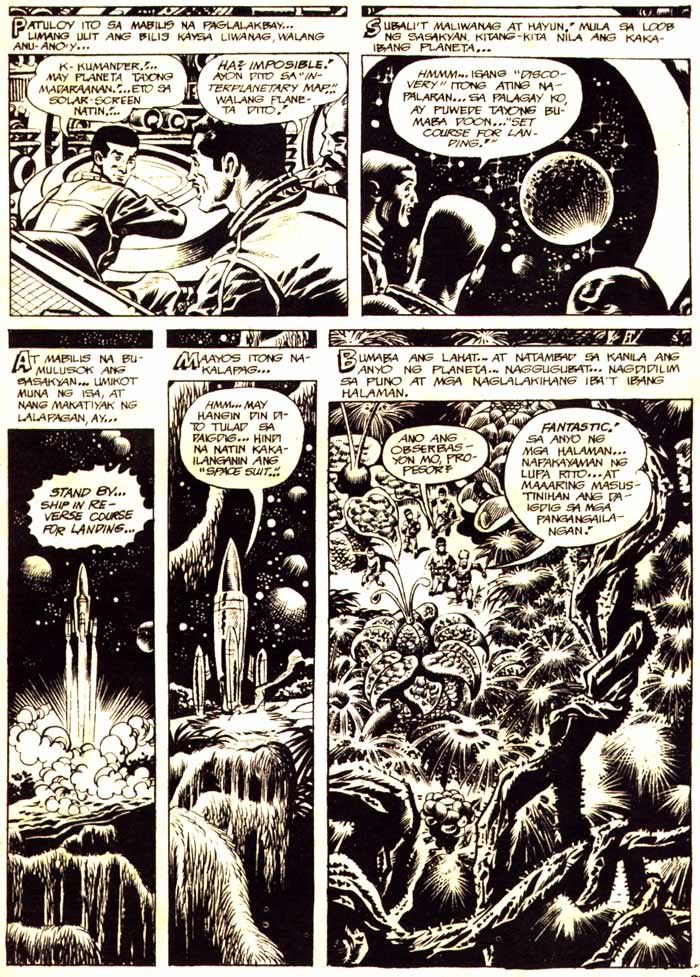
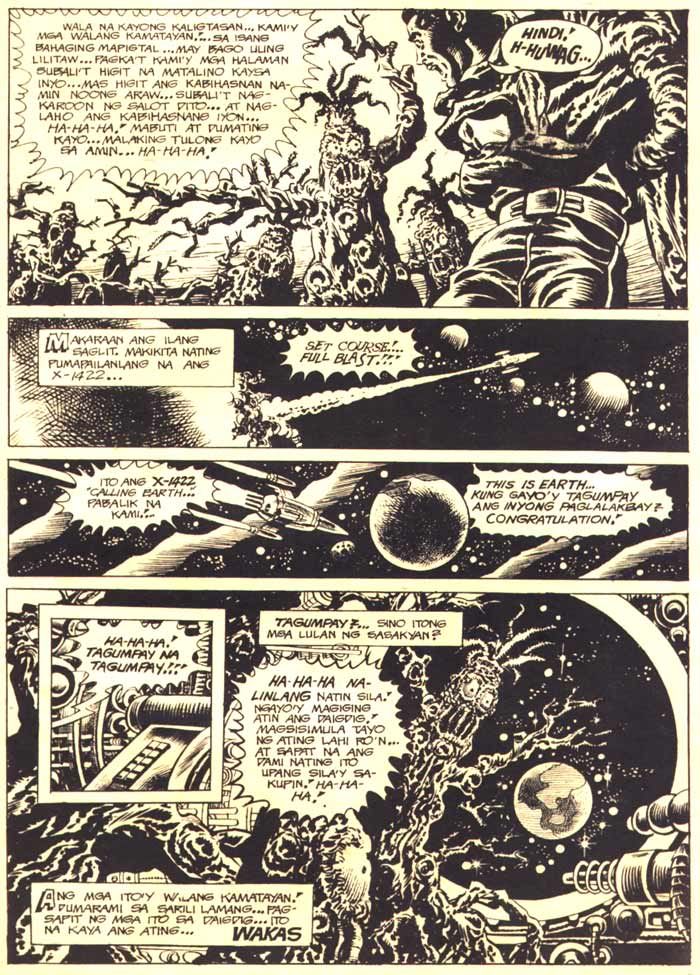
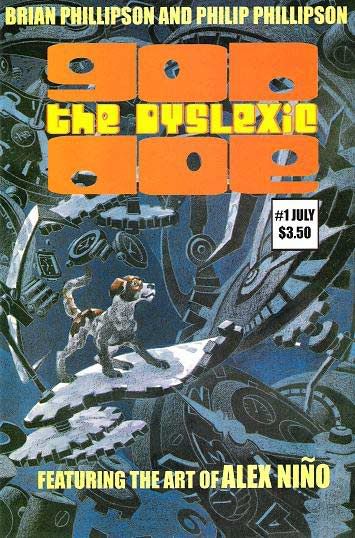
God the Dyslexic doG. Art by Alex Niño


More Alex Niño Comics!


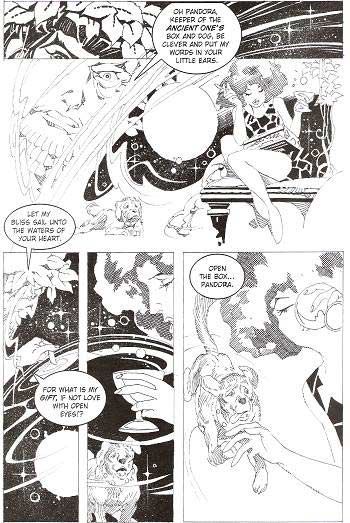
Alex continues his return to comics as featured artist on God the Dyslexic doG. The comic book is created and written by the father and son team of Philip and Brian Phillipson. If the artwork below is any indication, Alex has not only NOT lost it, but he's as innovative and as ground breaking as ever. Go Alex!


On the Official Site is a shot of the full wraparound artwork to the cover above. Sample art from the comic book below.


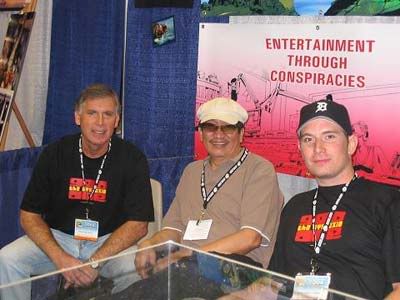
Creators Philip Phillipson, Alex Niño and Brian Phillipson at the recent San Diego Comicon where the first issue was launched.

For more information, more art and more pics from San Diego con, go to the God the Dyslexic doG Official Site.

God the Dyslexic doG
http://www.godthedyslexicdog.com/index.html


Monday, August 02, 2004


Frankenstein Mobster

Alex Niño returns to comics in a big way! After 2003's SUNN for I-Books, Alex Niño continues his return to comics with a cover for Mark Wheatley's Frankenstein Mobster #6 from Insight Studios Group, published by Image Comics.


This issue (#6) is currently being solicited in this month's Previews, which will be released in October so feel free to pester your local comic book shop to carry it. Mark Wheatley tells me in their Insight Studios Message Board that there will a a large preview of the cover in the letters page of issue #5.

Yay! :)


FRED CARRILLO


Komiks Illustrator Fred Carrillo's profile is up in the Museum. It includes a biography and 8 pieces of rarely seen artwork from his work for ACE Publications as well as for DC Comics' Phantom Stranger.

FRED CARRILLO PROFILE

Saturday, July 31, 2004


More Art and Artists

I've had some requests to feature some artists, specially Ading Gonzales. I'm posting here some of those requested, as well as other artists I have not yet previously mentioned.

Ading Gonzales
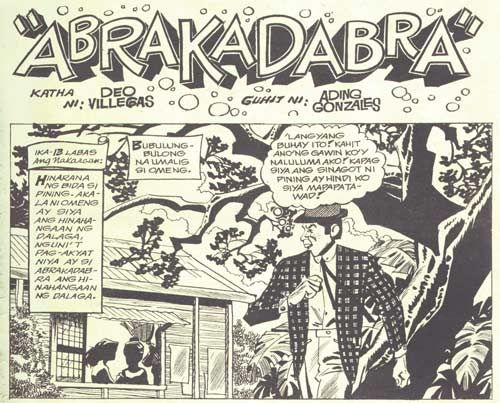

Abrakadabra
written by Deo Villegas
HIWAGA Komiks, July 30, 1965

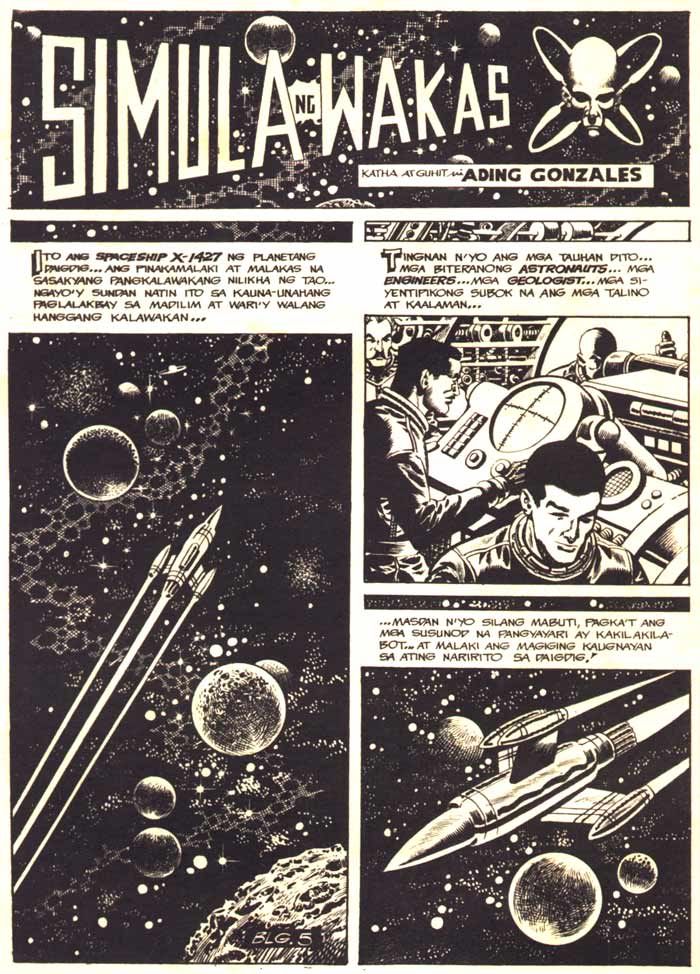
For more of Ading's art, linked below is a complete 4 page story "Simula ng Wakas" from Tagalog Klasiks #395, March 4, 1966

Simula ng Wakas 1
Simula ng Wakas 2
Simula ng Wakas 3
Simula ng Wakas 4

Dell Barras
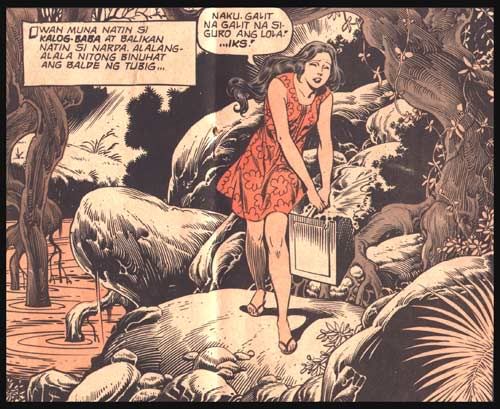

Darna at ang Black Widow
written by Mars Ravelo and Renato Mendoza
RAVELO Komiks-Movie Magazine #176, March 6, 1980

Dell is a regular visitor to this site, and has given us valuable assistance in our projects. Thanks Dell!

After establishing himself as an artist on Philippine comics working on titles such as Javlin and Darna, Dell has consequently worked on many US comics like New Mutants, The New Defenders, Whisper, Battletide, Avengers, Blue Beetle, Captain Thunder and Blue Bolt, Conan, Detective Comics, Teen Titans Spotlight and so much more.

Dell Barras Official Site

Rudy Nebres
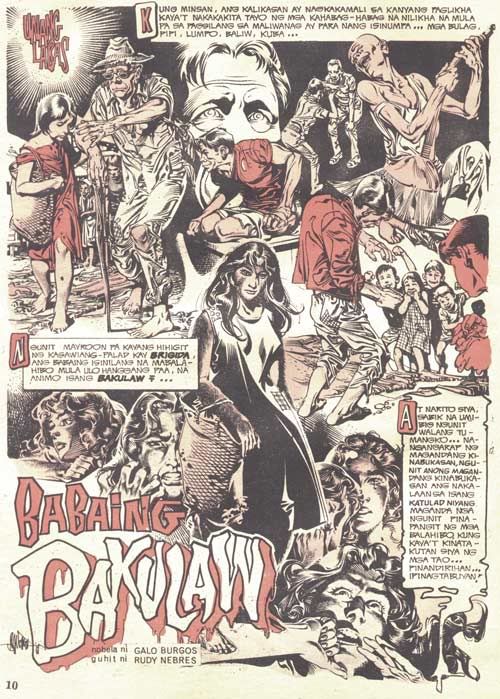

Babaing Bakulaw
written by Galo Burgos
ESPESYAL Komiks #291, July 19, 1965

Rudy is a very popular artist in the US where he has made quite a career for himself working on comics like Conan, Creepy, Crossgen Chronicles, Deadly Hands of Kung Fu, The Fly, Doctor Strange, Eerie, Goblin, The Incredible Hulk, Vampirella, and so much more. He has also released an art book, The Art of Rudy Nebres.

Ruben Yandoc
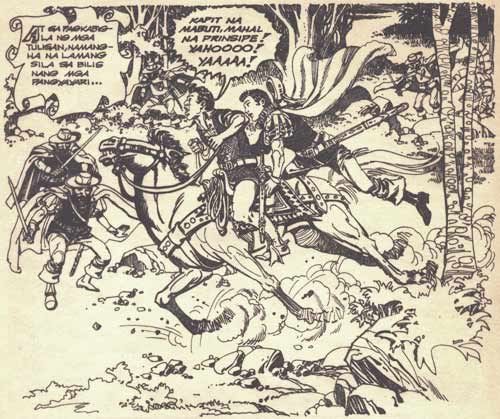

Don Del Oro
written by Ruben Yandoc
HIWAGA Komiks #338, January 29, 1965

Also known as Rubeny, Ruben Yandoc has worked on comics novels like PATAPON and Kasaysayan ng Mga Anghel (Kenkoy Komiks) and 29 (Tagalog Klasiks). In the US, Ruben is famous for working on such comics like GI Combat, Ghosts, House of Mystery and House of Secrets, Sgt. Rock, The Unexpected, Weird War Tales and so on.

Fred D. Marchadesch
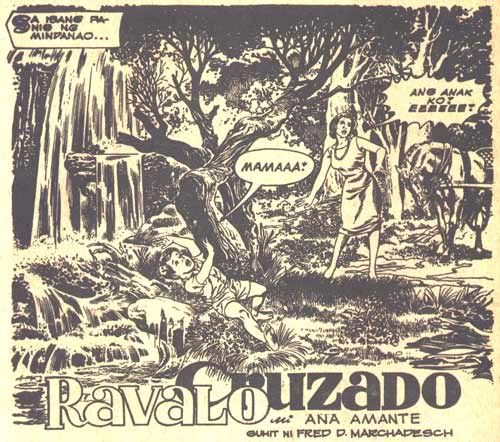

Ravalo Cruzado
written by Ana Amante
Pioneer Komiks #159, December 23, 1968

I actually hardly know anything about Fred, but I've seen his work on many comic books and he has shown that he's quite an excellent artist. If anyone has any info on him, please feel free to write. Thanks!

Yong Montaño
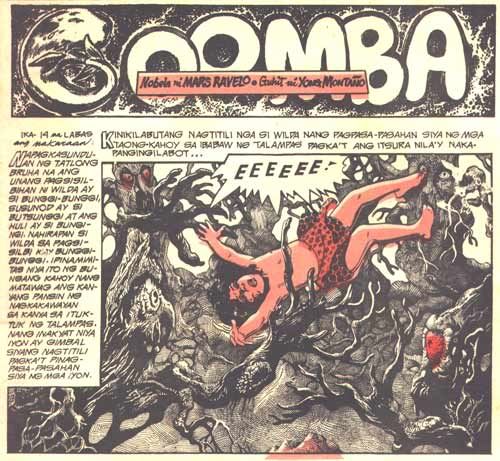

GOOMBA
Written by Mars Ravelo
Tagalog Klasiks #416
December 23, 1966

I've had the privilege of having my work appear with Yong Montaño on the pages of Terror Komiks, published by Mass Media Communications in 1992. I met him not too long ago and I was surprised to learn that he actually knew who I was.

Specializing in the horror genre, he has worked on comics in that genre, including the aforementioned Terror Comics, as well as comics published in the US like Monsters Unleashed, Tales of the Zombie, Vampire Tales, Marvel Chillers, Haunt of Horrors and Giant Size Werewolf.

Museum Update

Just uploaded is the "About" section of the online museum, explaining the rationale behind the existence of the site, and what you can expect to see in it in the coming year. I'm reposting it here:

*************************

ABOUT THE PHILIPPINE COMICS ART MUSEUM ONLINE

Ever since I came online in 1997, I have come to realize that a lot of Filipinos, specially the young artists reading comics and trying to enter comics as a career, are not familiar with the great Filipino Komiks Masters of yesteryear. I myself have since learned about many artists I never knew before who were all quite talented and had impressive bodies of work. As I rediscovered page after page of these artworks, I became much more in awe of the talent of these Filipinos, and I felt stricken that such artworks are virtually unknown today.

It thus became more imperative to find ways to share this with the current generation of Filipinos and with the rest of world. Several plans have been put in motion to fulfill this objective. The San Pablo City Comics Art Festival in December
2003 done by the Komikero Artists Group is just the start. The next is the publication of a book about the "Masters of Philippine Komiks Art", a tentative schedule of release is 2006. Another plan set in motion is this online museum, a forerunner of what will hopefully be a true museum to be located here in San Pablo City.

Since early this year, I have spent a small fortune acquiring old komiks and original artwork from the 1940's up the present. Lack of finances put a pause on my acquisitions, but I will still continue with it when I have the means. I presently have a small collection of some 100 original artworks and 300+old komiks, mostly from the
50's and the 60's. I will gradually put up this material online with a substantial update to this online museum once a week.

Many of these artworks have not seen the light of day for decades, and in most cases have never been reprinted since they were first published.

I am glad that other groups have put into motion similar projects, specially the release of a Kenkoy graphic album by Tony Velasquez, published by Dennis Villegas.
Dennis is also in the process of putting up a Kenkoy Museum/store in Cubao, and is planning more reprints of more great masters.

Aside from these, I am also in talks with the Francisco V. Coching Foundation to reprint in complete volumes, the komiks novels that Coching is probably most famous for, Barbaro(1952) and El Indio(1953).

Because of the work I've put into these projects, I've had to shelve or postpone a lot of the personal projects I have planned for myself like the Komikero Portfolio book (I think our old masters deserve a publication like that more than me.), The Ultimate Chicken Story, and adaptions of Noli and the Legends of the Seven Lakes of San Pablo. As for the other projects, like Siglo Passion, Alamat Anthology, and various work for abroad for Graphic Classics, DC and Cliffhanger of course, are still all on track.

As mentioned, this online museum will be updated once a week, but the news/journal page will be updated several times a week. In a year, hopefully the collection uploaded herein will be as comprehensive as I can make it.

Thursday, July 29, 2004

Cal Sobrepeña Passes Away


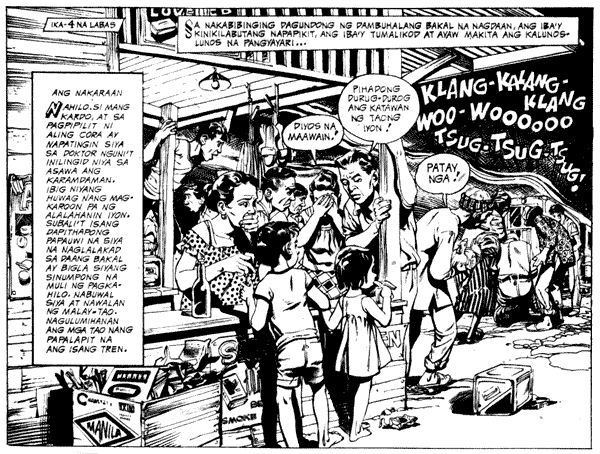
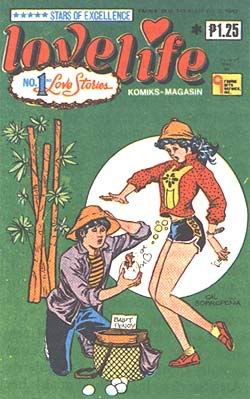
Komiks illustrator Cal Sobrepeña, also known as "Peping Calusa", has died. He has worked on such comics novels as VERTUD and KARPOB and is well known for illustrating many covers for Lovelife Komiks for Graphics Arts Service,Inc (GASI).

Monday, July 26, 2004


Nestor Redondo's Quo Vadis


Uploaded in the museum is the 2nd half of QUO VADIS, an adaptation of MGM Picture's 1951 motion picture written by Clodualdo Del Mundo and drawn by Nestor Redondo. This adaptation so impressed MGM bigwigs that they sought to hire Redondo as in house artist and offered to fly him to the United States. But Redondo declined, feeling that he was perhaps too young to make the move.

This adaptation was serialized in Tagalog Klasiks #91-92, pubished by ACE Publications in 1953 to promote the film that was set to be released in the country that year. It has never seen print anywhere else since it was first published. Many consider QUO VADIS as Nestor Redondo's masterpiece, and yet few people today have seen it. I'm happy to have the opportunity to share this with all the visitors of this site.

However, I was only able to get the last 8 pages of the 16 page adaptation, and I'm still working to get the first 8.

Nestor Redondo's Quo Vadis

Friday, July 23, 2004


I just wanted to share this cover of a comic book I just got today. It's the cover to Pilipino Komiks #180 drawn by Francisco V. Coching. It was published on April 24, 1954. It's one of the most remarkable covers of Philippine komiks I've seen, and it's my absolute favorite as of this moment.

Thursday, July 22, 2004


Nestor Redondo Profile


Nestor Redondo's profile is finally up! I can't believe I haven't done so before now, but it's OK as it gave me time to find some really kick ass Rendondo art that hasn't been seen most likely since they were first publised decades ago.

Uploaded are some covers, original artworks, page scans from comics Nestor did both here in the Philippines and in the US.

NESTOR REDONDO PROFILE
http://www.komikero.com/museum/redondo.html

Wednesday, July 21, 2004


Manga and Western Style


I'm a lurker on some local mailing lists on comics, and while I do post occassionally on some, like the Artist's Den mailing list, I just sit back and observe on others (which will remain nameless). Back in my day, it seems there were very few like me who were interested in drawing comics. It's so different now, with aspiring comics writers and artists popping up all over the place.

Once in a while an artist would come up who shows extraordinary potential and eventually make it big, like Leinil Francis Yu and Philip Tan and watch out for this guy: Mico Suayan.

One of the things I notice in these mailing lists is the notion that style is narrowed down to just Manga, and Western Style, like no other style exists but those two. If an artist doesn't draw manga, it automatically means he's drawing in the Western style. And it's a notion that I find to be terribly puzzling.

The question of what Western style is must be answered. Just what is Western style? Is it Jim Lee's popular style? Or Mike Mignola's style? Or Jack Kirby's style? Or is it Alex Raymond's style? Upon closer inspection, all these Western artist's style are so vastly different from one another. How can all these be lumped into one "Western style"?

And we haven't even talked about Moebius, Ladronn, or Herge, proponents of the "clear line style" so popular in Europe, which are so vastly different from art made by Americans. How about the Australians? The South Africans? The Malaysians? They all create comics too, and their artists there have their own unique individual style.

And this is why manga is so unique. The Japanese artists were able to create something that has an undeniably similar look, allowing for a certain amount of individuality between artists.

You take this comic book test. Take a comic book without looking at its cover and look inside. If it's manga, you will be able to tell instantly that it is. But if you were shown the art of someone like Lat, you can immediately tell that it's NOT manga, but most people won't be able to tell just where this art originated. Same is true for Desire Atsain or Ondrej Sekora. You know immediately that it's not manga, but you won't know from where that art comes from. Those three examples come from Malaysia, Ivory Coast and Czechnia respectively.

If the styles outside of Japan are so varied and within Japan so similar, it only goes to show how strong Japan is as a nation, and it is their unity and uncompromising patriotism that makes them a political, economic and cultural force to reckon with.

So yes, there's MORE than just Japanese and "Western" in ways of drawing comics. Lots LOTS more. Check out comics not just manga, or those coming from DC or Marvel, but those coming from the independents too. There's a whole galaxy of comics out there just waiting to be read.